News and Events
Tobacco Retailer Landscape in Gilchrist County
March 16, 2026
Community leaders and health advocates in Gilchrist County are taking a closer look at the number and location of tobacco retailers across the county and what that could mean for youth exposure to tobacco products. Current data shows that 32 tobacco retailers operate throughout Gilchrist County, selling products such as cigarettes, cigars, smokeless tobacco, and e-cigarettes. Within the county’s municipalities, the city of Trenton has 13 retailers, while the city of Bell has six retailers. Understanding where these stores are located helps community leaders and prevention groups better evaluate how tobacco products are marketed and accessed locally.
The data also shows that some retailers are located close to each other and to youth-centered spaces. In Trenton, five tobacco retailers, about 38 percent, are located within 500 feet of another retailer, creating clusters where tobacco products are heavily available in a small area. Across the county, four retailers, about 13 percent, are located within 300 feet of a school, raising concerns about the visibility of tobacco products to students.
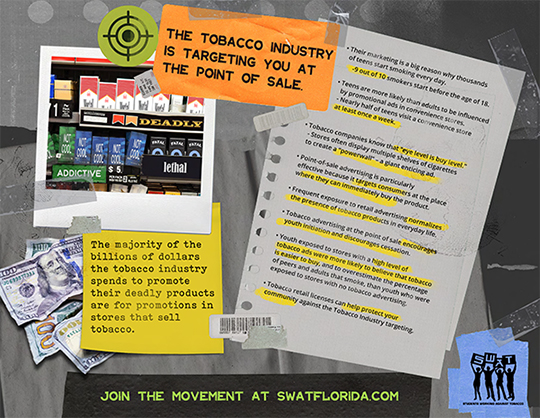
Exposure to tobacco marketing in retail stores is common. In Gilchrist County, 75.8 percent of youth reported seeing tobacco advertisements the last time they visited a retail store. These advertisements are often placed near checkout counters or on colorful displays designed to attract attention and encourage impulse purchases.
Enforcement data also highlights potential concerns. Inspections conducted by the U.S. Food and Drug Administration show that Gilchrist County has a 23 percent violation rate for sales to minors. Additionally, among youth who reported using tobacco products, 26.8 percent said they obtained at least one product from a commercial source, such as a store.
Communities across Florida have begun exploring ways to address these concerns through local land-use policies. Zoning policies can help regulate where tobacco products are sold by limiting retailer locations near schools, parks, and other youth-centered spaces or by reducing how closely retailers can be located to one another. Currently, seven local governments in Florida, including neighboring Dixie County, have adopted some form of tobacco point-of-sale zoning policy.
Public opinion data suggests many local residents support these types of efforts. In Gilchrist County, 57.9 percent of adults support prohibiting tobacco sales in stores located near schools, while 43.6 percent support prohibiting sales near parks. Local youth advocates and community partners continue working to raise awareness about the tobacco retailer landscape and its potential impact on young people. Through education and community engagement, these efforts aim to encourage conversations about how Gilchrist County can continue promoting healthier environments for youth and families.